
HVAC Marketing Budget: How Much to Spend at $1.5M
Chris Graham · May 14, 2026 · Updated September 16, 2026
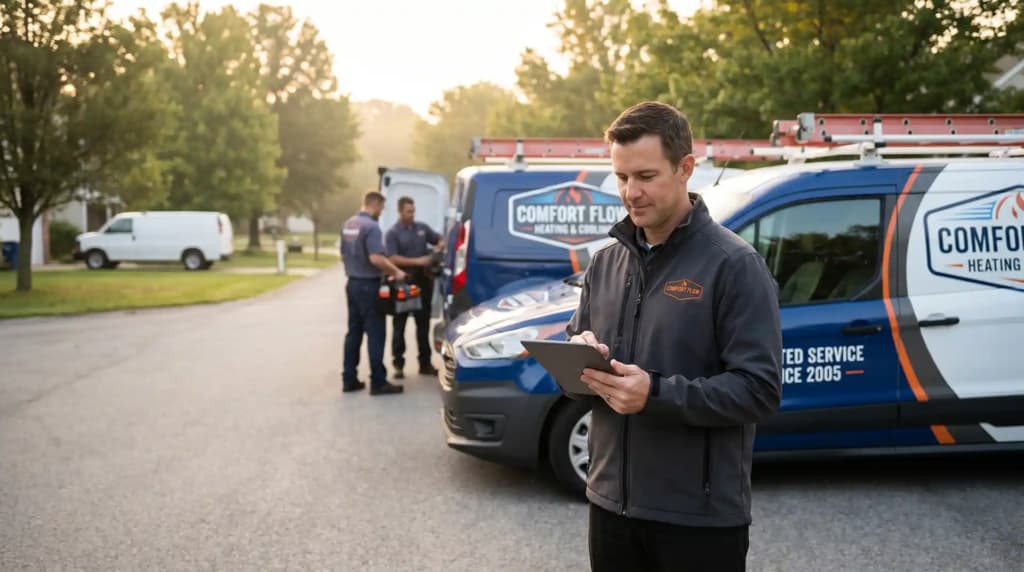
Most HVAC owners ask this question backwards. They start with "what percentage should I spend on marketing?" The better question is: what kind of growth do I actually want, and what will it realistically take to get there?
A company trying to maintain steady business needs a very different budget than a company trying to aggressively grow market share. And here's the truth most agencies won't tell you: if your branding is unclear, your website looks average, your Google presence is weak, or your trucks blend in with every competitor in town, no amount of spending fixes the leak.
More traffic doesn't fix a weak foundation. Clear brands convert better. Confusing brands get price-shopped.
Start with what you already spend
Most HVAC companies we talk to at this size are not starting from zero. The owners we build for are usually already spending somewhere around 6% to 8% of revenue on marketing. At $1.5 million per year, that is roughly $90,000 to $120,000 a year, or about $7,500 to $10,000 a month, spread across ads, lead services, an agency or two, the website, and the trucks.
So the useful question is not how much more to add. It is how hard the money you already spend is working.
Make the existing spend work harder
This is how we approach it with Fleet-First Marketing, the ongoing stage of Fleet-First Branding™ for BrandBlueprint clients. It is not a new layer of spending on top of what you have. It reorganizes the investment you are already making so every dollar builds the same brand.
- It starts with the brand. Improvements begin as the BrandBlueprint rollout takes effect: the trucks, website, Google profile, reviews, and social all carrying one clear direction.
- The 9 to 12 month objective is less dependence on paid advertising. Paid ads stop the day you stop paying. Organic work (search visibility, reviews, content, a website that confirms who you are) is the part you keep.
- You choose what to do with the difference. As paid dependency comes down, the owner decides whether to take it as savings, put it back into growth, or some of both.
This matters because putting more into paid ads is how HVAC companies burn cash fast. You stop paying, you stop showing, and you own nothing when it ends. A lot of contractors don't have a lead problem. They have a trust problem, a differentiation problem, or a conversion problem. Customers can't tell why they're different, so they compare on price.
Where most HVAC companies waste money
- They buy leads instead of building visibility.
- They rent attention with ads instead of building a brand they own.
- They hire agencies focused on clicks instead of booked jobs.
- They use generic messaging that sounds like every other HVAC company.
"Quality service." "Family owned." "Professional technicians." That describes almost everyone. If your marketing looks interchangeable, customers default to cheapest price, fastest availability, or whoever has the most reviews. That's not a strategy. That's survival mode.
A smarter allocation
For a $1.5M HVAC company, a balanced way to divide the spend you already have might look like this:
| Category | Approx budget |
|---|---|
| SEO & Google presence | $2,000–$4,000 |
| Website improvements | $500–$2,000 |
| Reputation management | $300–$800 |
| Content & social media | $1,000–$3,000 |
| Vehicle wraps & branding | Varies |
| CRM / follow-up automation | $300–$1,000 |
The exact numbers matter less than the principle: your marketing should build long-term trust assets, not just temporary leads. That means better visibility, stronger reviews, clearer positioning, recognizable branding, higher conversion, repeat business, and referral momentum.
The hidden cost of "cheap marketing"
Cheap marketing usually creates expensive problems. You save money upfront, but weak execution leads to low-quality leads, poor close rates, inconsistent branding, wasted spend, and constant price shopping. Eventually the owner concludes "marketing doesn't work." In reality, unclear marketing didn't work. There's a difference.
Measure this instead of "leads"
More leads does not automatically mean better marketing, and organic leads alone are not the scorecard either. Judge it at the business level: total cost to acquire a customer (including every fee, ours included), number of new customers, revenue, and profit. Underneath that, track booked calls, close rate, average ticket, maintenance-agreement growth, repeat rate, Google review growth, and branded search volume. Good marketing should improve visibility, trust, and conversion, not just traffic.
The real budget question
The percentage matters less than whether the money you're already spending is connected and building the same brand. If you're spending 6% to 8% of revenue and not seeing the growth that should buy, adding more is rarely the answer. Usually it's a structure problem: four or five disconnected vendors who don't talk to each other, each working from a different idea of who you are.
Fixing the structure starts with the brand. A BrandBlueprint sets your positioning, your message, and the guardrails your trucks, website, Google profile, and yard signs each work inside, so everything you spend after it builds the same brand.